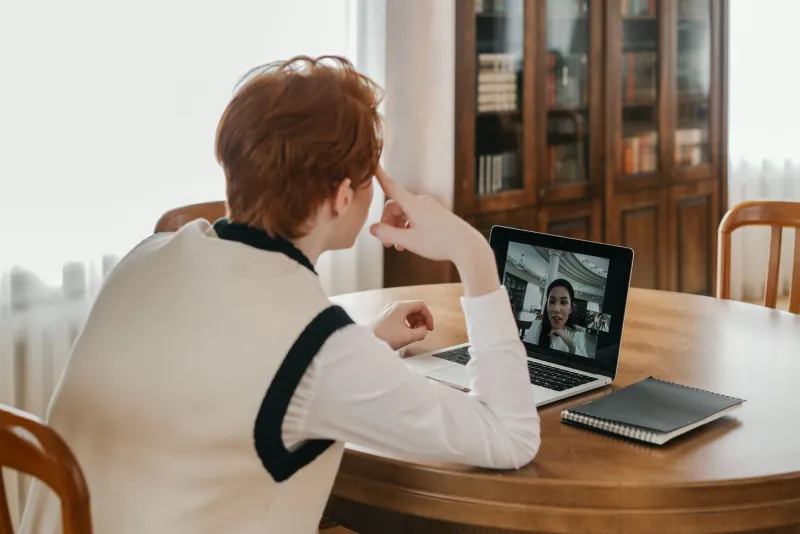
Somewhere between the second agenda item and the passive-aggressive silence that follows someone sharing their screen, you contributed meaningfully to a work meeting. You made a joke. You answered a question. You said "that's a great point" at exactly the right moment to seem engaged without doing any real work.
None of it happened. Technically. Because you were on mute.
And now you know. And the knowing is a specific kind of bad.
The Moment the Floor Drops Out
It always starts with someone saying your name.
Not in a warm way. In the way where there's been a pause, and that pause has lasted long enough that the meeting host has started doing the thing where they squint at their grid of thumbnails like they're trying to locate a specific car in a parking garage. "Hey — did we lose you?"
You look down at your taskbar. The little microphone icon has a line through it. A small, merciless line.
The internal audit begins immediately.
You start mentally rewinding the last ten minutes of your own participation. There was the part where you pushed back on the timeline. The part where you explained, clearly and with real conviction, that the proposed rollout date wasn't realistic. The part where you laughed at Dave's joke so Dave would feel good about himself. All of it — gone. Absorbed into the void. A performance reviewed by no audience.
The Mathematical Calculation Nobody Prepared You For
The next phase is triage, and it happens fast.
You are now running a rapid cost-benefit analysis on everything you said while muted, ranked by how much it would hurt your professional reputation to repeat it versus how much damage has already been done by the silence.
The joke? Not repeatable. Jokes don't survive being explained. "I actually said something funny earlier, can I — " No. That's not a sentence a person says.
The pushback on the timeline? This one's borderline. It was a good point. It was your best point, honestly. But saying it again means admitting you weren't heard the first time, which means admitting you were muted, which means admitting you didn't know you were muted, which opens the door to the question of how long you didn't know, which you are absolutely not prepared to answer.
The "great point" affirmation for Karen's idea? That one you can let go. Karen seemed fine.
The Cover Story Assembles Itself
Here's the thing about the mute realization: by the time you've fully processed it, your brain has already started building an alternative narrative.
You weren't accidentally muted. You were strategically muted. You are the kind of serious professional who stays on mute to minimize background noise, as a courtesy to your colleagues, because you respect everyone's time and also possibly because you are a former audio engineer who understands acoustics at a granular level.
This is the story. You're committing to it.
You unmute with the energy of someone who has been listening very carefully and is now choosing, deliberately, to speak. You say something that sounds like a summary of your earlier comments but is technically new. You use the phrase "building on what's been discussed" even though what's been discussed was largely your own internal monologue.
Nobody questions it. Dave nods. Karen seems pleased.
The Specific Shame of Watching Your Own Muted Mouth
The part that stays with you, though — the part that replays at low volume during lunch — is the visual.
Because you were on camera. Your face was visible the entire time. Which means your coworkers watched you speak, with full facial expression and apparent conviction, while hearing nothing. They saw you react to your own comments. They watched you chuckle slightly at your own joke. They observed you doing the small nod that means yes, exactly, I agree with myself.
For ten minutes, you were a muted nature documentary. A human, in their natural habitat, communicating with nobody.
At some point, someone probably noticed. They almost certainly said nothing, because saying something would have required them to interrupt the meeting to announce that you looked like a malfunctioning video game NPC, and that's not really a thing you do to a colleague.
So they watched. And you talked. And it was fine, technically.
The New Protocol You Will Absolutely Not Follow
You tell yourself, as you leave the meeting, that this will never happen again. You will check your mute status before speaking. You will establish a visual indicator system. You will perhaps invest in a physical mute button with a light on it, a real one, the kind podcasters use, because you are a person who has learned from experience and adapted accordingly.
You will not do any of this.
Next Tuesday, same time, you will be back in the same grid of thumbnails, explaining your concerns about a deadline to an audience of zero, fully confident that your points are landing, until someone says your name in that particular way and the floor drops out again.
It's fine. You were on mute on purpose. You always are.
That's your story and you're keeping it.