Asphalt Theater: How the Parking Lot Reveals Your True Self
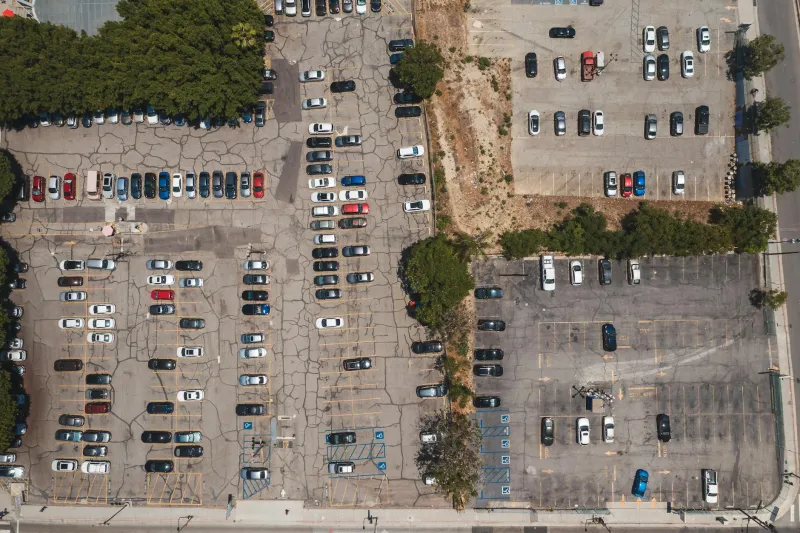
The Democracy of Desperation
There's a peculiar thing that happens the moment your car enters a parking lot. Your brain doesn't just switch into "find a spot" mode. It enters a kind of low-grade, perpetual negotiation with physics, fate, and the moral character of strangers.
You know the feeling. You're circling. Not frantically yet—just methodically, like a shark that's decided the shopping center is its ocean. A spot opens up. It's fine. Not ideal. It's next to the cart corral, which means your door will be kissed by a rogue shopping cart at some point, but it's there, and it's available.
But here's where the internal monologue begins: Is it worth it? That's only, what, 40 extra feet to the entrance? But that's 40 feet there, and 40 feet back, and you're already tired, and—wait, is someone pulling out three rows over?
You've now been circling for seven minutes.
The Sacred Art of Spot Claiming
Everyone pretends parking lot rules don't exist. Everyone also knows exactly what they are.
If you're idling in front of a space with your blinker on, that space is yours. This is universally understood. It's the parking lot equivalent of calling dibs in elementary school—it has the weight of international law. Someone pulling in from the other direction? They see your blinker. They know. They understand. And yet, sometimes they don't care. They pull in anyway, and suddenly you're locked in eye contact through windshields, and a silent, furious conversation is happening:
You: "I was clearly waiting for this."
Them: "I didn't see you."
You (internally): "You're a liar and I hope your groceries are wet."
They park. You circle onward, a victim of asphalt injustice.
The Fifteen-Minute Gamble
There's a specific brand of optimism that emerges when you spot someone loading bags into their trunk. They're leaving. You can feel it. You position your car at a respectful distance—close enough to be next in line, far enough to seem casual, like you just happen to be parked here thinking about your life.
They're loading. Still loading. How many bags? Did they buy the entire store?
Now they're backing out. Your hands tighten on the wheel. This is it. This is your spot. You can feel the universe rewarding your patience—
And someone from the other direction darts in.
It's not even a good spot. It's worse than the one you passed five minutes ago. But they took it, and now you're forced to confront an uncomfortable truth: you wasted fifteen minutes for nothing, and you're somehow angrier about that than you would've been if you'd just parked far away in the first place.
The Unspoken Hierarchy
Parking lots operate on a strict social order that nobody acknowledges but everyone respects.
Spots near the entrance: For people in a hurry, pregnant people, people with kids, the elderly, and—mysteriously—one person who is just very confident about their right to be there.
Spots in the middle: For normal people doing normal shopping. Acceptable. Fine. No one's happy, but no one's angry.
Spots at the far end: For people who either don't care, are driving a massive truck, or are trying to make a statement about their life choices.
The compact spots: A trap. A beautiful, obvious trap. You know you don't fit. Your car is not a compact car. You just want to believe it might be.
The Peak of Absurdity
The parking lot reaches maximum absurdity at the grocery store on a Sunday afternoon. This is when the desperation becomes almost visible—a fog of determination and mild rage hanging over the asphalt.
People are making three-point turns to exit spaces they've decided are insufficient. Someone is arguing with someone else about whether a space was "clearly theirs." A man in a sedan is genuinely considering a spot that requires him to park so close to the line that no human could possibly exit their vehicle with dignity.
And everyone—everyone—is convinced that if they just wait another five minutes, a better spot will appear. It won't. There are no better spots. There are only spots, and the spots you've already rejected, and the growing realization that you've wasted enough time that you could've walked from the far end of the lot and back three times over.
The Acceptance
Somewhere around the twelve-minute mark, something shifts. You stop looking for the perfect spot. You stop calculating distances. You simply accept the next available space like it's a gift from the parking lot gods, and you move on with your life.
Until next time. When you'll do it all again.
Because the parking lot isn't really about parking. It's about the small, daily proof that we're all just slightly feral creatures pretending to be civilized, and 144 square feet of asphalt is all it takes to reveal exactly how much we care about things that don't matter at all.